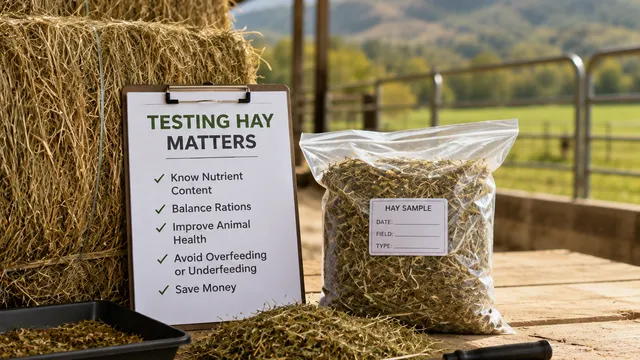
Hay is often the foundation of a livestock feeding program, but not all hay provides the same nutritional value. Two bales can look nearly identical while supplying very different amounts of protein, energy, minerals, and digestible nutrients. For that reason, forage testing is one of the most useful tools livestock producers can use to make informed feeding decisions.
Laboratory testing provides the most accurate estimate of hay quality. Testing can turn an educated guess about a bale of hay into actual information that can be used to develop a more appropriate ration.
Appearance Doesn't Tell the Whole Story
Producers commonly evaluate hay by looking at its color, leafiness, texture, smell, and maturity. Those observations are useful, but they cannot provide a complete picture of nutritional value.
NC State Extension notes that leaves contain approximately two to three times as many nutrients as stems, making leafy hay generally more desirable. Bright green hay can also indicate better retention of certain nutrients, while excessive browning may indicate nutrient loss or heat damage. A moldy odor can be a warning that hay was baled too wet and may have developed mold.
However, even attractive-looking hay can vary considerably in nutritional content. Laboratory analysis provides information that cannot be reliably determined simply by examining a bale.
What Does a Hay Test Tell You?
A forage analysis can provide several important measurements, including:
- Dry matter: Indicates how much of the feed is actually nutrients and other dry components rather than water.
- Crude protein (CP): Helps determine whether the hay supplies adequate protein for the animals being fed.
- Fiber measurements: Acid detergent fiber (ADF) and neutral detergent fiber (NDF) help estimate digestibility and potential intake.
- Energy: Measures such as total digestible nutrients (TDN) help determine whether the forage can meet an animal's energy requirements.
- Minerals: Calcium, phosphorus, magnesium, potassium and other minerals may be reported, helping identify potential deficiencies or imbalances.
- Potentially harmful compounds: Depending on the forage and circumstances, additional testing may be appropriate for substances such as nitrates.
NC State Extension explains that forage laboratory results estimate the nutritive value of a forage, but animal performance also depends on factors such as forage intake, digestibility and anti-quality constituents.
Hay Quality Affects Animal Performance
The ultimate measure of forage quality is how animals perform. NC State Extension identifies measures such as milk production, weight gain and reproductive efficiency as examples of animal responses influenced by forage quality.
This is particularly important because livestock have different nutritional requirements. Hay that is adequate for a mature, nonproductive animal may not supply enough nutrients for a growing calf, lactating cow, replacement heifer, breeding animal or performance horse.
Testing allows producers to match the feed to the animal rather than assuming that all hay is nutritionally equivalent.
Testing Can Save Money
One of the biggest advantages of hay testing is the ability to avoid overfeeding expensive supplements.
For example, if a hay test shows that forage already provides adequate protein, routinely adding a high-protein supplement may provide little benefit. Conversely, if the hay is low in protein or energy, testing can identify the shortfall so that supplementation can be targeted appropriately.
This approach can make a feeding program both more economical and more precise. Rather than purchasing supplements based on assumptions, producers can use actual forage analysis results to determine what nutrients are needed.
Relative Forage Quality Can Help Compare Hay
NC State Extension discusses two commonly used indices for evaluating forage: Relative Feed Value (RFV) and Relative Forage Quality (RFQ).
Both indices combine information about forage nutritive value and estimated animal intake to provide a single number that can be useful for ranking forages. In general, a higher value indicates higher forage quality. NC State notes that when RFV and RFQ differ, RFQ is generally the preferred index.
Importantly, these indices do not replace the individual nutrient measurements needed to balance an animal's ration. They are tools for comparing forage quality and matching forage to livestock requirements.
Testing Is Especially Important When Buying Hay
For producers purchasing hay, forage testing can help determine whether the price being paid is justified by the hay's nutritional value.
Hay may vary because of:
- Plant species and variety
- Stage of maturity at harvest
- Fertility
- Weather conditions
- Leaf-to-stem ratio
- Harvest and curing conditions
- Storage
- Whether the hay was damaged by rain or excessive heat
NC State research and Extension publications emphasize that forage maturity and other production factors can have substantial effects on the nutritive value and quality of conserved hay.
Testing hay from different fields, cuttings or lots can therefore help producers determine which forage should be fed to which group of animals.
Sample Hay Correctly
A hay test is only as useful as the sample submitted to the laboratory. The sample needs to represent the hay being fed.
Producers should sample hay by lot—hay that was harvested from the same field, at approximately the same time, under similar conditions. Different cuttings, fields, forage species or distinctly different bales should generally be considered separate lots.
A core sample from multiple bales is generally more representative than grabbing a handful of hay from the outside of one bale. Producers should follow the sampling and submission instructions provided by their forage laboratory or Extension service.
Don't Wait Until There Is a Feeding Problem
Forage testing is most useful when it becomes a routine part of the feeding program rather than something done only after animals fail to perform.
Testing can help producers:
- Determine the nutritional value of available hay.
- Match different hay lots to different classes of livestock.
- Identify protein or energy deficiencies.
- Develop more accurate supplementation programs.
- Avoid unnecessary supplementation.
- Detect potentially important mineral or forage-quality concerns.
- Make more informed hay-buying decisions.
- Improve consistency in livestock nutrition.
A Small Investment With a Big Payoff
Hay is a major feed resource, and its nutritional value directly affects the productivity and economics of a livestock operation. Because visual inspection cannot reveal all of the important characteristics of forage, laboratory analysis provides valuable information for making sound feeding decisions.
The central message from NC State Extension is straightforward: laboratory testing is the most accurate way to estimate hay quality. A forage analysis can help producers move from guessing about hay quality to managing nutrition based on measurable information.
For livestock producers, that makes forage testing more than just another management task. It is an important part of building an efficient, economical and nutritionally sound feeding program.
If you are interested in testing your hay, stop by your local Extension Center at 39 South Main Street or call (828) 479-7979.